
Orthographic Mapping: A Very Weak Theory
This theory was "invented" by Linnea Ehri.

This is an excerpt from my book, ‘Understanding the Science of Reading: Context Matters’. It will be published by Guilford.
Podcast version of this article:
In this chapter excerpt, I try to make sense of orthographic mapping, a term invented by Linnea Ehri and introduced in Chapter 15 (Ehri, 2014). We’ll start with her definition:
“Orthographic mapping occurs when, in the course of reading specific words, readers form connections between written units, either single graphemes or larger spelling patterns, and spoken units, either phonemes, syllables, or morphemes. These connections are retained in memory along with meanings and enable readers to recognize words by sight. An important consequence of orthographic mapping is that the spellings of words enter memory and influence vocabulary learning, the processing of phonological constituents in words, and phonological memory” (Ehri, 2014, pp. 5-6)
This is written with all the stunning clarity of a Rorschach inkblot. Let’s do a bit of unpacking.
Unpacking
Orthography. Orthography has to do with symbols representing sounds and the arrangement of letters. The written language system you’re currently using is an orthographic system. You’re putting sound symbols together to create words. Other written language systems use symbols to represent things. These are called logographic. A logo is a symbol representing something. Here, you’re putting symbols together to create meaning (see Figure 1).
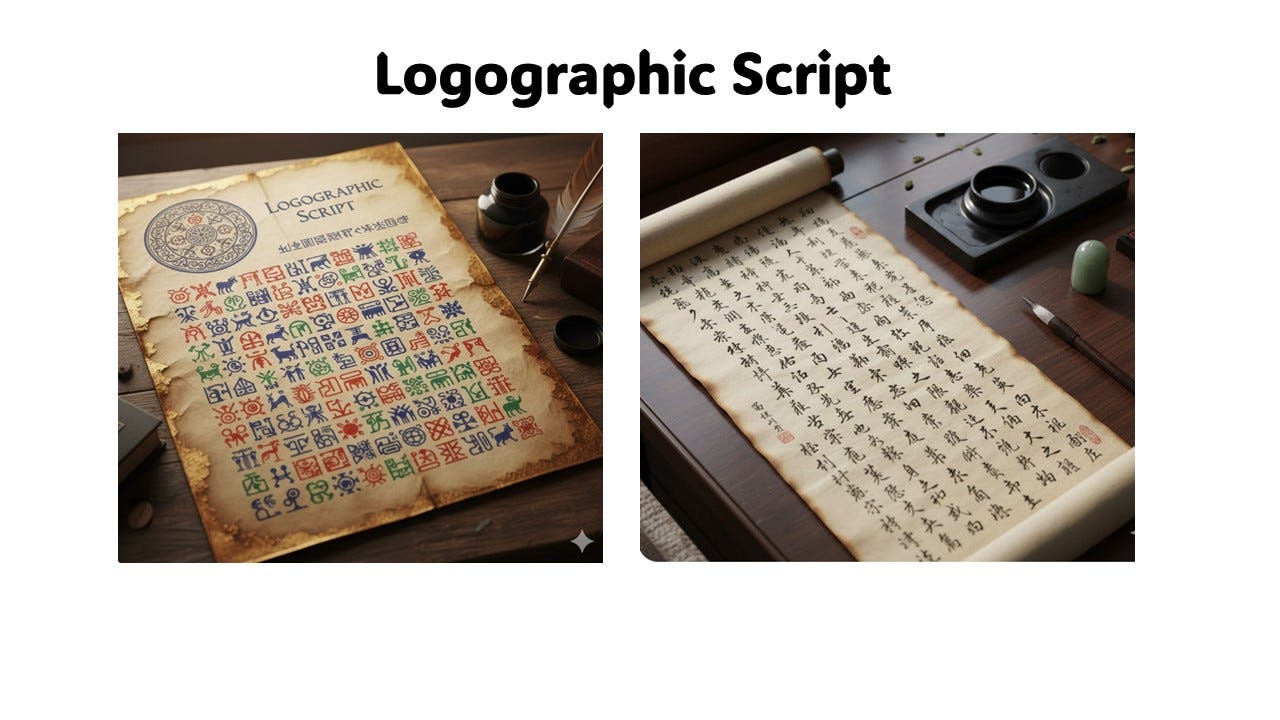
Figure 1. Logographic script.
Mapping. Mapping in a cognitive sense refers to how things are stored or connected in LTM.
Orthographic mapping. As stated above, orthographic mapping is the cognitive process by which readers store written words in LTM. Ehri calls these sight words. Readers are able to effortlessly retrieve these and use them to recognize words during reading. Orthographic mapping makes letter-sound connections and bonds these to the spelling, pronunciation, and meanings of words in LTM (see Figure 2).
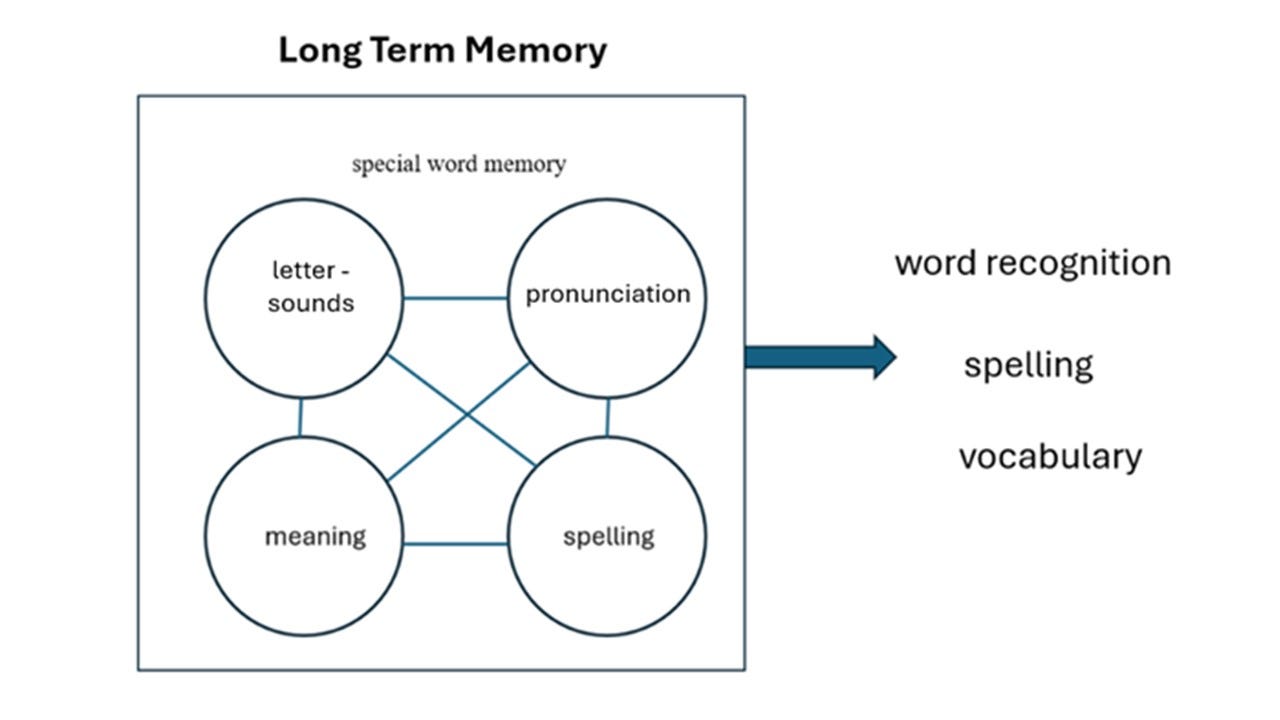
Figure 2. Orthographic mapping.
Upward lexical repurposing. Upward lexical repurposing is when important-sounding words are combined to make non-things sound like important things. Research has shown that upward lexical repurposing (ULR) significantly enhances one’s ability to get grants, book contracts, consulting jobs, and large speaking fees (Jones, 2025). Orthographic mapping is an example of this.
Making Sense
It all makes sense, yes?
No. If knowledge were stored in LTM in the form of words, orthographic mapping might make a bit of sense. But knowledge is stored in the form of associative networks, not words (Robinson-Riegler & Robinson-Riegler, 2012). Things in LTM are connected to and organized around related things. Any mapping that takes place is primarily semantic mapping.
For example, when you hear the word ‘cat’ or see the word cat in print, you automatically associate it with cat things: soft, furry, paws, kitty, pet. These things are closely related to cats. The neural pathways leading to these things are activated. These things come to mind. What is NOT activated when you hear the word cat – you don’t automatically think of short /a/ words, or CVC words, or /at/ phonograms. You don’t think about letter sounds or letter patterns. You think of things. Clearly, we have access to semantic information when we see the word ‘cat’ in print. Yes, there is orthographic information on the page, and some orthographic mapping is stored in the head, but semantic information takes precedence over orthographic information.
And if we just walked around recognizing individual words floating in space, then the theory of orthographic mapping would make a small bit of sense. But as stated in Chapter 15, the semantic connections between words in long term memory are much stronger than any orthographic connection (Collins & Loftus, 1975; Craig and Tulving, 1975; Deacon & Kieffer, 2018; Domasio et al., 1996; Siew, 2019; Morais, Olsson, & Schooler, 2012; Rogers & Wolmetz, 2016; Siew, 2019). And reading is primarily a meaning-making process, not a word-recognition process. Orthographic mapping may be a thing, but semantic mapping is much more of a thing.
Orthographic Facilitation
Orthographic facilitation means seeing the spelling of words as you are learning them. This is another example of ULR. Ehri said orthographic facilitation improves vocabulary learning and spelling (Chambre, Ehri, & Ness, 2017). In a 2017 study with 45 first-grade students, she compared their memory of two novel sets of words. The first set contained just pictures of the novel word and a spoken definition. The other set contained pictures with the name of the word printed underneath, followed by a spoken definition. After two weeks, children were shown the picture and asked to remember the word associated with it and the meaning of the word.
It turns out that when the printed word was included with the picture, children remembered the pronunciation of it significantly better. Ehri reasoned that since pronunciation was the most difficult part of vocabulary learning (something I question), orthographic facilitation thereby enhanced vocabulary learning. This deductive logic is a bit of a stretch.
This is an example of a creative research-based conclusion. You can technically say that orthographic facilitation is a research-based strategy. There’s research to indicate it does something. But the research is not very good, and the something that it does is not really indicative of something else. Remembering the pronunciation of a word has very little to do with acquiring words.
Children learn between 3,000 and 4,000 words a year (Graves & Silverman, 2011). By the end of elementary school, they know approximately 25,000 and by the end of high school, approximately 50,000 to 80,000 words (Harp & Brewer, 2005). How much orthographic facilitation is taking place here? Children learn the vast majority of words with no orthographic facilitation. They learn them by hearing them used in conversation or by seeing the words in print.
In the study above, when children had letter clues as they were learning the pronunciation or sound of the word, they were better able to remember the sound of the word than when they had no letter clues. Yes. Seeing sound symbols as you’re learning the sound of a new word provides another modality for remembering the sound of the word. And if you have a visual representation of that sound while you’re learning the pronunciation, chances are that you’d be better able to remember the pronunciation. But most people could have told you that up front.
Orthography and Vocabulary Learning
There were two experiments described in this 2008 article (Rosenthal & Ehri, 2008). The first one was conducted with 20 second-grade students. They were given two sets of low-frequency CVC nouns, 12 words total. One set was taught with the word given orally, and a picture with the word printed on the picture. The other set was taught with the word given orally with a picture, but no word on it. Vocabulary learning was determined by assessing students’ ability to remember the pronunciation of the words and their meaning. It was found that these students could remember the pronunciation and meaning of the words better when it was accompanied by seeing the spelling of the word.
The second experiment was similar but was conducted with 32 fifth-grade students and 20 words. After one day, vocabulary learning was assessed with an oral cloze task. They were also asked to provide the words’ definition, meaning, and spelling. Seeing the word while learning it improved their memory of spelling, pronunciation, and meaning of the 20 words.
The authors concluded that “Elementary school students learned and remembered the pronunciations and meanings of new vocabulary words better when they were exposed to written forms of the words during study periods than when they only heard and repeated the words” (p. 186). These conclusions were then extended to vocabulary learning and reading.
Review: A sample size of 20 in one experiment asked students to remember 12 words, and 32 in the other group were asked to remember 20 words. One could hardly generalize to elementary school students in general. But the larger point is that this is a remembering experiment, not a vocabulary learning experiment or a reading learning experiment.
Dance Mapping
Yes, if you provide an additional variable (seeing the spelling of the word), this will likely enhance students’ ability to remember the pronunciation and meaning of that word. It does not mean that orthography provided a mnemonic device that tied the spellings of words to their pronunciation in memory. It does not mean that spelling became bonded to word pronunciations and meanings. It just means that this group of students remembered things better when you included spelling.
I would posit that if you had students do a little dance as they learned one set of words, the dance set would show similar results (see Figure 3). This does not mean that word learning is tied to dance. It just means that when you present multiple forms of data with a thing, or if you are more engaged with the thing when learning is occurring, that thing is more easily remembered (Craik & Lockhart, 1972).

Figure 3. Dance mapping.
Conclusion
Theories are used to explain a set of facts and understand phenomena. Theories are based on a set of research-based data. As such, they are neither right nor wrong; rather, they are robust or weak. The question is: Is Ehri’s theory of orthographic mapping robust or weak? Since it seems to conflict with much of the research in cognitive psychology related to memory, and the deductions made are based on rather “creative” interpretations of research, one must conclude that it is a weak theory. It’s also a silly theory.
References
Chambre, S., Ehri, L.’ & Ness, M. (2017). Orthographic facilitation of first graders’ vocabulary learning: Does directing attention to print enhance the effect? Reading & Writing, 30, 1137-1156.
Collins, A., & Loftus, E. (1975). A spreading-activity theory of semantic processing. Psychological Review, 82, 407-428.
Craik, F.I.M., & Lockhart, R.S. (1972). Levels of processing: A framework for memory research. Journal of Verbal Learning and Verbal Behavior, 11, 671-684.
Domasio, H., Grabowski, T.J., Tranel, D., Hichwa, R.D., & Damasio, A.R. (1996). A neural basis for lexical retrieval. Nature, 380, 499-505.
Eggen, P. & Kauchak, D. (2020). Using educational psychology in teaching (11th ed.). Pearson
Ehri, L. (2007). Development of sight word reading: Phases and findings. In M. Snowling & C. Hulme (Eds.), The science of reading: A handbook. Blackwell Publishing.
Ehri, L. (2014). Orthographic mapping in the acquisition of sight words, reading, spelling memory, and vocabulary learning. Scientific studies of reading, 18, p-21)
Ehri, L. (2007). Development of sight word reading: Phases and findings. In M. Snowling & C. Hulme (Eds.), The science of reading: A handbook. Blackwell Publishing.
Ehri, L. (2014). Orthographic mapping in the acquisition of sight words reading, spelling memory, and vocabulary learning. Scientific studies of reading, 18, p-21)
Fries, P.H., (2008). Words, context, and meaning in reading. In A. Flurky, E. Paulson, & K. Goodman (Eds.), Scientific Realism in Studies of Reading (pp. 53-82). Lawrence Erlbaum Associates.
Gotlieb, R., Rhinehart, L., & Wolf, M. (2022). The “reading brain” is taught, not born: Evidence from the evolving neuroscience of reading for teachers and society. The Reading League Journal 11-17
Graves, M.F., & Silverman, R. (2011). Interventions to enhance vocabulary development. In A McGill-Franzen and R.L Allington’s (Eds.), Handbook of reading disability research. Routledge
Higgins ET, Rholes WS, & Jones CR. (1977) Category accessibility and impression formation. Journal of Experimental Social Psychology. 1977;13:141–154. [Google Scholar|
Johnson, A. (2008). Teaching reading and writing: A guidebook for tutoring and remediating students. Rowman Littlefield Education.
Johnson, A. (2017). Teaching strategies for all teachers. Rowman and Littlefield.
Johnson, A. (2021). Designing meaning-based interventions for reading. Guildford Press.
Johnson, A. (2022). The human dimension in Education: Essential Learning theories and their impact on teaching and learning. Rowman and Littlefield.
Jones, T. (2025). Don’t be silly. I made this one up. But I’m glad you checked. That shows you’re checking my sources. This is a good thing.
Lane. H.B., & Allen, S. A. (2010). The vocabulary-rich classroom: Modeling sophisticated word use to promote word consciousness and vocabulary growth. The Reading Teacher, 63, 362-370.
Robinson-Riegler, B. & Robinson-Riegler, G., (2012). Cognitive psychology: Applying the science of the mind (3rd ed). Pearson.
Rosenthal, J., & Ehri, L. (2008). The mnemonic value of orthography for vaculary learning. Journal of Educational Psychology, 100, 175-191.
National Institute of Health (Retrieved June 2025). About neuroscience. US Department of Health and Human Services. https://www.nichd.nih.gov/health/topics/neuro/conditioninfo
Siew, C., (2019). Spreadr: An R package to simulate spreading activation in a network. Behavior Research Methods, 51, 910-929.
In a recent Substack posting, a practitioner colleague HJ gives her description of an application of the theory of orthographic mapping, She states that "all word work is uniting phonology, orthography and meaning to facilitate orthographic mapping, concluding that "the first line of defense when faced with an unknow word is decoding." This colleague presents the example of a second grader who read the word "rewrap as rew-rap. The student figured out, apparently on her own, to change /oo/ to /ee/ and "find a friendly word." Our colleague concludes that "only when this decoding attempt has been secured do we look to pictures, syntax, or semantics to confirm our choice if necessary."
This example of a teacher's approach to a miscue gives me the opportunity to describe how this colleague's approach to a miscue using metalinguistic theory, including phonemic awareness and a reader's knowledge of phonics to analyze the miscue and decide upon instructional strategies to assist the reader in decoding, as well as simultaneously building her metalinguistic awareness. My analysis of this miscue leads me to conclude that the origin of the miscue resides in two aspects of word recognition. The student attempted to decode the word by applying her syllabic awareness but misread the word for two reasons: 1) a lack of knowledge that "re" is a morpheme (a commonly used morpheme from Latin) and therefore is pronounced as a syllable in and of itself and 2) that the letters "wr" are a digraph for the phoneme /r/.
Consequently, this miscue offers the teacher the opportunity for increasing the reader's metalinguistic knowledge about how morphemes convey (cue) meaning and how digraphs represent single phonemes. This miscue is not an example of the so called "three-cueing system" because the term refers to grapho-phonics, semantics and syntax. Morphological awareness is not differentiated in the miscue analysis research because miscues originating in word processing miscues in a student's oral reading performance but can be the origin of semantic or syntactic miscues. The reader in this example, IMO did not decode the word rewrap because she was not reading for meaning, but when she realized the meaning of the word from context, she was able to decode it accurately, despite her possible lack of awareness of the phonemic representation of the digraph "wr". It is worth noting that if the reader is a Spanish speaker reading in Spanish, a miscue of a word with the morpheme "re" would be highly unlikely because "re" is always a distinct CV syllable. I make this point because orthographic mapping in Spanish, a more transparent orthography than English, would not encounter this problem.
I provide this analysis to point out one of the reasons why for those of us who are researchers in biliteracy and second language reading among multilingual learners find the theory of orthographic mapping to be incomplete without metalinguistic analysis that affirms how reading for meaning enables decoding and is not just to "confirm our choices." As I posted earlier, we must pay attention to the dual-route model of decoding. Correct pronunciation of a written word does not automatically lead to its comprehension and incorrect decoding (miscues) are oftentimes originate from the reader's lack of knowledge of the meaning (semantics) of the word. We must not overlook opportunities to increase readers' metalinguistic awareness and explicit metalinguistic knowledge through teachers' scaffolding of their oral reading miscues.
Ke, S. E., Zhang, D., & Koda, K. (2023). Metalinguistic awareness in second language reading development. Cambridge University Press.
This analysis cuts right to the implementation question I'm grappling with in South Africa's multilingual classrooms.
Your point about orthographic mapping theory being developed primarily with English learners is critical. We're seeing a troubling pattern where 'best practice' workshops cite research about mother tongue instruction (often using examples from transparent orthographies like Bantu languages) but then train teachers in English-medium methods based on opaque orthography research.
The cognitive processes children use to map in isiXhosa (where i-n-d-l-u maps predictably) are fundamentally different from those needed for English (where 'rough, through, though, cough, bough' follow no such logic). Yet policy discussions treat this as a simple transfer problem rather than a systems capacity issue.
I'm documenting this as 'knowledge washing' - where accurate research gets deployed to construct narratives that protect institutional positioning rather than serve implementation reality. Your examination of orthographic mapping's theoretical limitations provides essential grounding for understanding why these transplanted methods fail at scale.
Would be interested in your thoughts on how research translation across linguistic contexts could be more rigorous.