
Reading and the Information Processing Model: Why Penguins Continue to Mishear What I Say
* This is an excerpt from my book, Being and Becoming Teachers of Reading: A Meaning-Based Approach, published by Routledge in 2028

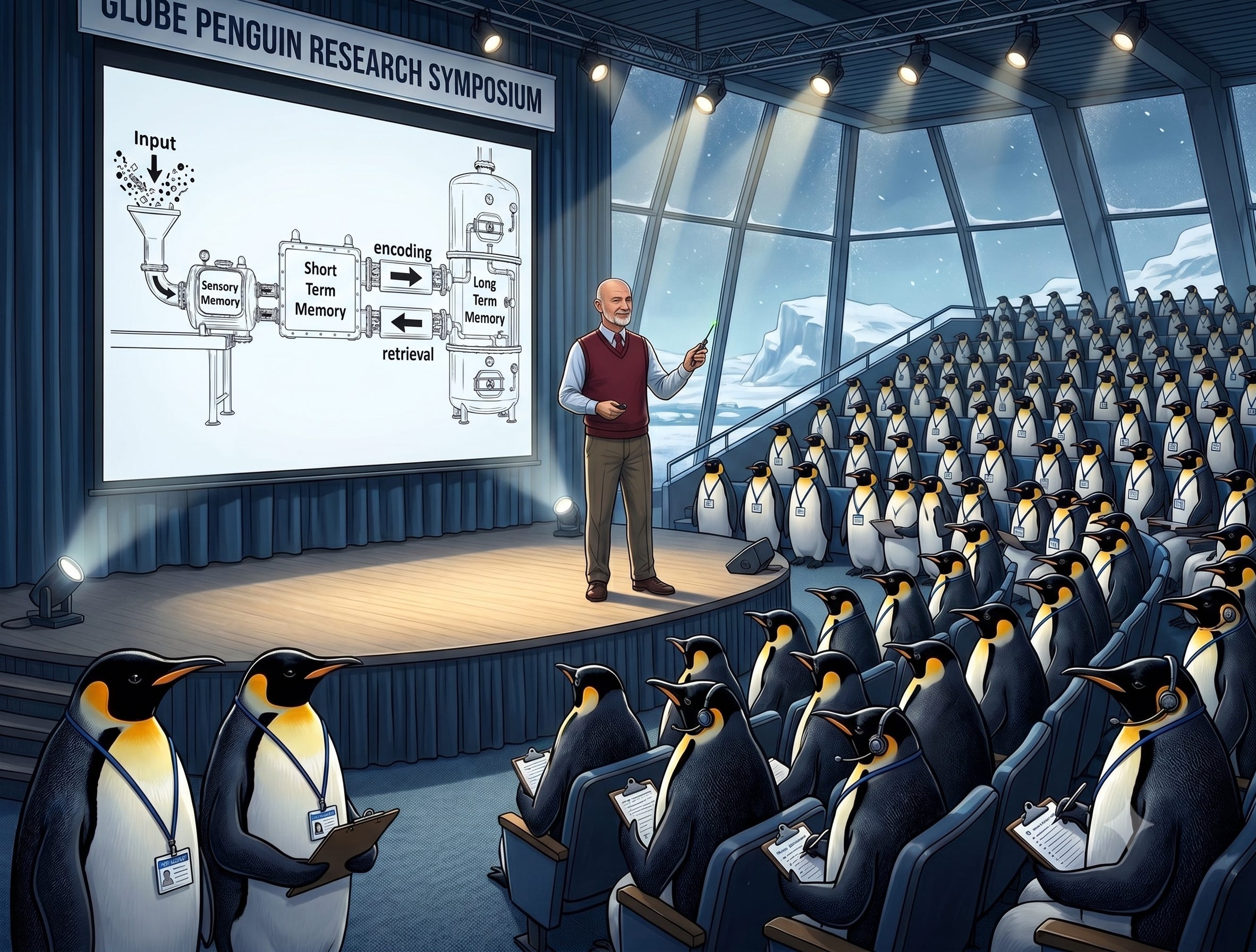
Purpose statement: The reader will develop a basic understanding of reading from a cognitive perspective.
Behavioral objective: After reading this chapter, the reader will be able to explain why penguins continue to insist that Dr. Johnson doesn’t believe in direct and explicit phonics instruction.
Important Terms
Sense memory – where data from your senses are initially stored. A large amount of data can be held here, but it fades within one to three seconds.
Short term memory (STM) – sense data that is given attention is stored here. STM can hold 7+/-2 bits of information for about 15 seconds.
Everybody - the opposite of nobody. It means all people. None are excluded. All are included.
Direct and explicit phonics instruction – something everybody believes is necessary for beginning readers, but not sufficient. How phonics instruction is delivered and how much is needed varies greatly dependent on the student. It is not the cause of all reading problems nor the answer to all reading problems.
Sound it out - something you should never ask children to do.
Chunking - organizing bits of data into larger meaningful units.
Large unit phonics - a type of phonics instruction that teaches students to recognize and identify words by looking for recognizable parts within the word instead of isolating individual letter sounds.
Working memory – the space within STM where stored knowledge from LTM is used to analyze, organize, and restructure the new information.
Schema - a mental framework depicting how information is organized in your head. Schemas are used to help you quickly understand new situations, events or information without having to relearn or process every detail.
Automaticity – using a skill or performing a cognitive operation without having to think about it.
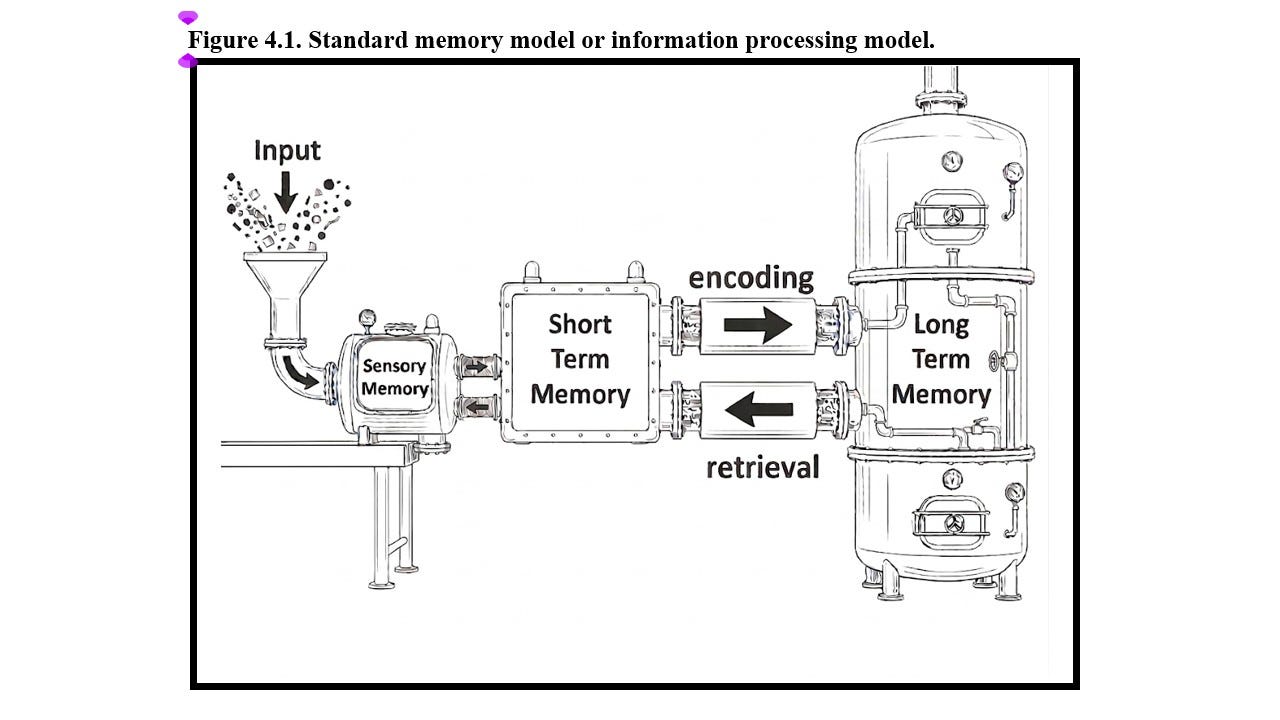
Encoding – the process of transforming information received from your senses into knowledge that can be organized and stored in long term memory.
Retrieval – the process of locating information stored in long term memory and bringing into short term memory so that you are consciously aware of it.
Long term memory (LTM) – the library in your head that stores your knowledge of facts, skills, and your life episodes. It has a virtually unlimited capacity for a virtually unlimited duration.
Dr. Johnson – a neurotic little bald man desperately in need of attention.
Reading is a thinking process, not a responding-to-stimuli process or a sounding-out-words process. And since cognitive psychology studies human thinking; it makes good sense to examine the reading process from a cognitive or thinking perspective using the information processing model.
The Information Processing Model
Part of reading involves taking in information from the text.This information is held in three kinds of memory holding tanks: sense memory, short-term memory (STM), and long-term memory (LTM) (see Figure 4.1).The information processing model, sometimes called the standard memory model, represents how we take in information as well as how we analyze, store, and retrieve it (Ormrod et al, 2020). This is how it works.
Sense Memory
Sense data are the stimuli we encounter in the form of our five senses. In terms of reading, sense data are the perceptions of squiggly shapes on the page. Sense memory, sometimes called sensory memory, is where this original sense data are held. It has an unlimited capacity; but a very short duration. It retains an exact copy of what’s perceived but only for about one to three seconds before it begins to fade
Short Term Memory
Short term memory (STM) is like a small holding tank for data from sense memory. Short term memory has a limited capacity. Most people can hold seven bits of information for about 15 seconds before it begins to fade. The capacity of the STM holding tank is 7+/-2 (seven plus or minus two) bits of information. This means that some can hold up to nine bits and some only five bits. That’s not a lot of information. Working memory (described below) is the space within short term memory where you do something with the data that’s there.
Holding more bits. Chunking enables you to hold more information in your STM holding tank. Chunking is the process of organizing bits of data into larger meaningful units so that we can make more efficient use of the limited space in STM. Consider Figure 4.2. Which is easier to process and recall: (a) 16 individual numbers, (b) eight double digit numbers, (c) four dates associated with meaningful events, or (d) four dates associated with meaningful events presented in chronological order?
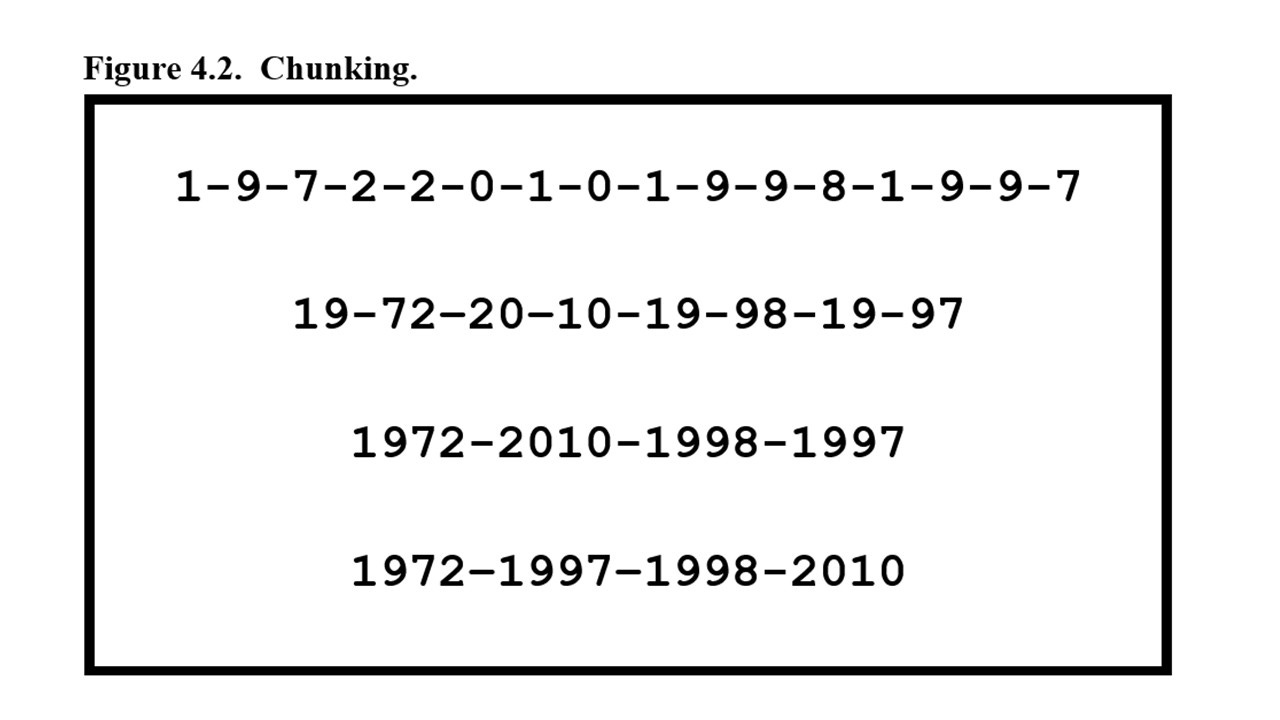
Also, if the numbers in Figure 4.2 were just meaningless squiggles, there could be no chunking. This tells us you need to have some knowledge of numbers, dates, and chronology for chunking to occur. Chunking occurs because knowledge flows into the STM holding tank from the LTM holding tank.
In the last chapter, kindly old Mrs. Peterson asked Little Timmy if there were parts of the word that he recognized. She was directing him to look for chunks of information instead of individual letters. Attending to four chunks of information in STM (in, for, ma, and tion) is easier than 11 individual letters. The name for this type of instruction is large unit phonics. Here children are taught to decode words using familiar letter patterns or chunks instead of individual letters.
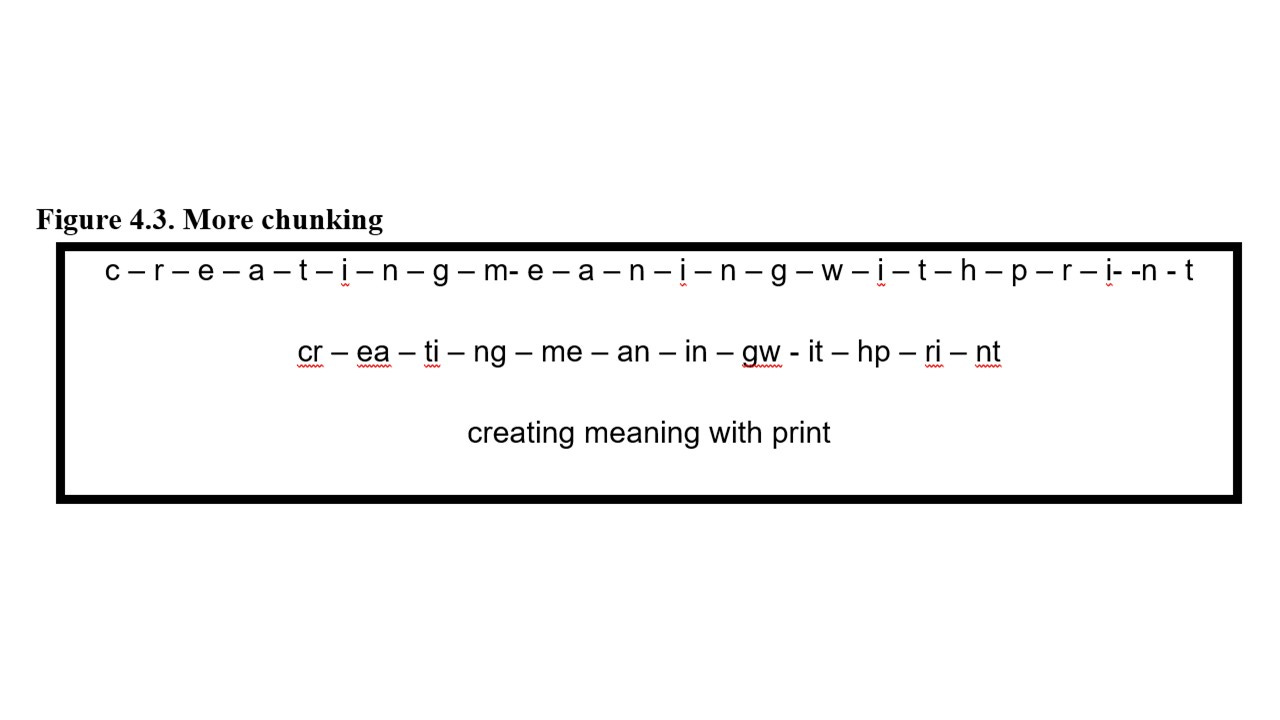
Sound it out. The limited capacity of STM explains why asking Little Timmy to look at each letter and “sound it out” is such a bad idea. Trying to hold all those letters in STM leaves no room to make sense of things or to create meaning. You can hold seven letters, or seven words, or seven ideas in STM. Which do you think might be the most efficient and effective in terms of creating meaning with text (see Figure 4.3)?
“So, you’re saying we shouldn’t teach phonics.”
No. I’ve never said or written anything remotely resembling that statement.
“But you just said trying to hold individual letters in STM wasn’t very efficient and effective.”
You seem unable to grasp this rather important point, so I’m going to repeat it again: Everybody believes that direct and explicit phonics instruction is a necessary part of early reading instruction. Everybody. Not nobody, somebody, or anybody. Everybody. It’s not the ‘what’ of phonics instruction that’s at issue; it’s the ‘how’ and the ‘how much’ of phonics instruction. This will all be explained in Chapter 28.
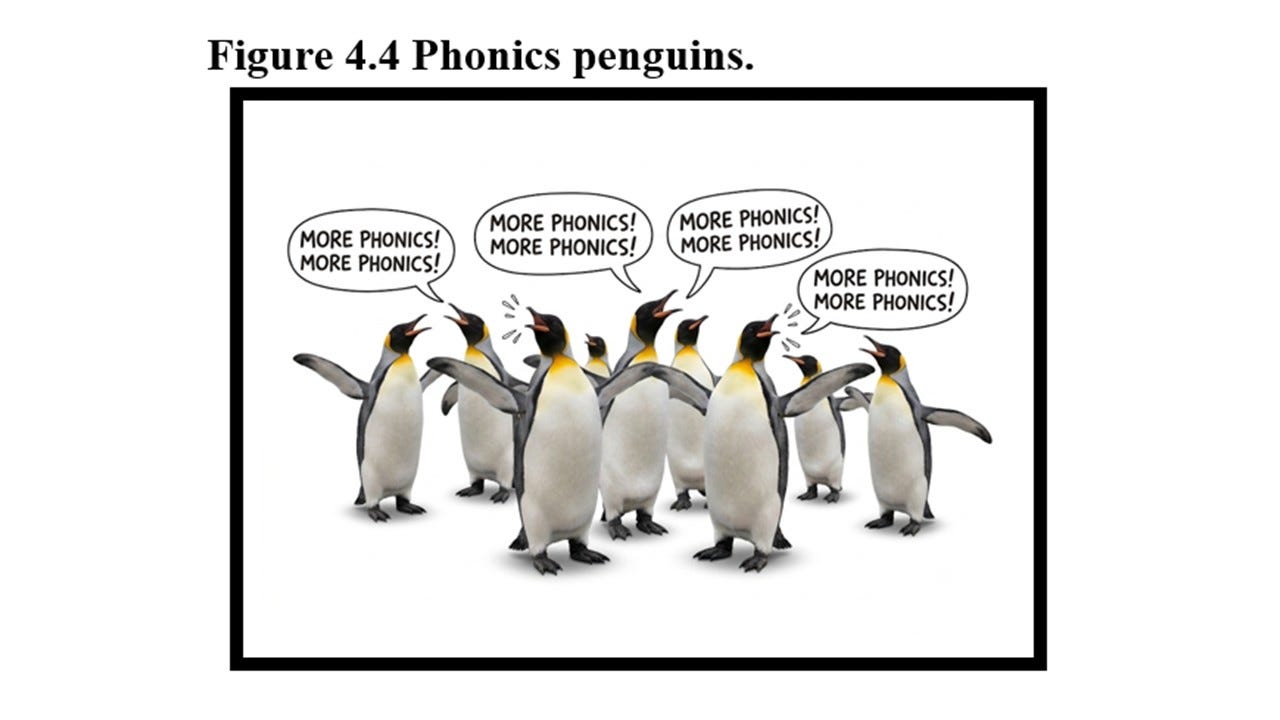
No matter how often I make this point, my penguin friends continue to insist that I and other meaning-based reading practitioners don’t believe in direct and explicit phonics instruction. It’s not that penguins are bad people (or bad penguins) (see Figure 4.1); rather, they just have the wrong sort of stuff in their LTM holding tanks. Somebody filled them up with inaccurate or incorrect information. Who would do such a thing? This bad information flows into their STM holding tank from LTM and taints everything in it. So, when I say things like, “Everybody believes that direct and explicit phonics instruction is necessary for beginning readers,” my penguin friends hear things like:
“Dr. Johnson doesn’t believe in phonics instruction.”
“Balanced literacy doesn’t include phonics instruction.”
“Whole language teaches children to guess at words.”
“People like Dr. Johnson have caused a massive reading crisis.”
“Teachers aren’t teaching phonics in our schools.”
“Dr. Johnson is teaching students to hate America.”
“Dr. Johnson worships Satan.”
Working memory. Working memory is the workbench in STM where you do something with the information. This is where metacognition takes place. This is also the place where you connect new information with stored knowledge; and use stored knowledge to analyze, organize, and restructure the new information. In other words, we use what’s in our head to make sense of what’s on the page.
To illustrate, right now, as you are reading about reading instruction, there’s a file folder on your cognitive workbench called a schema. A schema represents how information is organized in LTM. This particular schema contains everything you know about reading instruction, including your own experiences reading and learning to read. You’re connecting this knowledge with the new information found on this page. Based on this, you’re analyzing, evaluating, and deciding which information is interesting and useful, which is irrelevant, and which is totally kooky. When you find some interesting or important ideas, the little person in your head will put these in your file folder and put the folder in a place in the file cabinet where you can find it again when needed. This process is called encoding. Finding the desired file folder in LTM, putting it on the workbench, and selecting specific bits of knowledge is called retrieval.
Automaticity. Automaticity is the act of performing a procedure or operation without thinking about it or with very little conscious awareness. This occurs when the steps or processes involved with a particular skill become automatic. For example, as we drive, most of us don’t have to consciously think about pressing the gas pedal or turning the wheel. We respond to the curves and stop signs we encounter automatically with very little conscious attention. If we had to devote a lot of our attention to each of these functions, we would have less attention available for driving conditions. As a result, we would be far more likely to drive into something.
Automaticity in reading usually refers to word recognition skills. Recognizing words automatically enables students to devote more space in STM to comprehending what they are reading. Chapter 47 contains a variety of strategies that can be used to help students recognize words automatically as they read. And just like learning to drive a car, automaticity comes with practice. Hence, an effective research-based strategy is to simply have students practice reading every day (Allington, 2012; Krashen, 2004).
Long Term Memory
LTM is the library in your head where three types of knowledge is stored: (a) semantic knowledge or informational knowledge, (b) procedural knowledge, your knowledge of skills or how to do things, and (c) episodic knowledge, the knowledge of the episodes in your life or your autobiographical memories (Eggen & Kauchak, 2007). These are three distinct memory systems that each store knowledge differently.
LTM has a virtually unlimited holding capacity for a virtually unlimited duration. This means that everything you’ve ever experienced or learned is packed away in a file folder someplace. It’s not a matter of storage (or encoding); rather, it’s a matter of retrieval.
“So why is it we forget things?”
Sometimes new information and experiences can get in the way (interference), making it difficult for the little person in your head (your conscious mind) to find where they put certain bits of stored knowledge. But it’s there and available with the right prompt. Think of how a song or a smell can bring you back to a trivial experience you thought you had long forgotten. As teachers, we always want to connect new things with known things to facilitate encoding and retrieval.
“What does this have to do with reading?
Remember, there’s a two-way flow of information to and from each of the holding tanks. We use the knowledge stored in LTM in two ways. First, we use it to recognize words during reading. And second, we use it to make sense of and comprehend what we’re reading (Cervetti & Wright, 2020).. This will be explained more in depth in the next chapter.
Final Word
This is certainly not the complete cognitive psychology picture. I’ve just presented some of the important bits for understanding reading. I’ll end this chapter by saying that you don’t have literal holding tanks, a workbench, or a little person in your head. Also, there aren’t libraries, file cabinets, or file folders in your head. To help you understand and encode this new information, I included images and concepts with which you were most likely familiar (file folders, little people, etc.). This is a common writing trick based on cognitive psychology. It’s used to enhance your ability to encode new information and retrieve stored knowledge. These are called metaphors and similes.
The Reading Instruction Show
If you’re looking for accessible, research-based information that slices through the endless loads of overly worded baloney, I would encourage you to subscribe to my free Substack, The Reading Instruction Show.
Substack: The Reading Instruction Show

References
Allington, R.L. (2012). What readlly matters for struggling readers: Designing research-based programs. Boston, MA: Pearson
Cervetti, G., & Wright, T. (2020). The role of knowledge in understanding and learning from text. In E. Moje, P. Afflebach, P. Enciso, & N. Lesaux (Eds.). Handbook of reading research, Volume V. Routledge.
Eggen, P. & Kauchak, D. (2007). Educational psychology: Windows on classrooms (7th ed.). Upper Saddle River, NJ: Pearson.
Krashen, S. D. (2004). The power of reading: Insights from research (2nd ed.). Portsmouth, NH: Heinemann.
Ormrod, J., Anderman, E., & Anderman L. (2020). Educational psychology: Developing learnings (10th ed). Pearson.