
Reading Instruction, Whole Language, and a Flux Capacitor: It Was Always About Money

This is an excerpt from my book, ‘Making Sense of the Science of Reading: Teachers Matter’, published by Guilford sometime in 2027.
Podcast version of this article
Preservice Reading Methods Courses
The single Reading Methods course taken as part of my teacher education program at the University of Wisconsin-River Falls back in 1981 was largely gobbledygook to me. That was due, in large part, to the fact that I was not at all interested in the topic. Imagine that. A future literacy professor found the topic of reading instruction to be of little interest.
Somehow, I managed to cram enough reading stuff in my brain to pass the tests. But to be honest, that’s all I really wanted to do, pass the tests. If a little incidental learning occurred along the way, well that was just peaches. As a result, I left my nine-week Reading Methods course with a shallow and disjointed knowledgebase related to the small amount of reading stuff that I managed to temporarily paste in my brain. And most of this stuff seemed to quickly leak out of my head.
I’m sure my mindset back then was not much different from that of many of the undergraduate students in my recent Literacy Methods courses.
My understanding of reading instruction entering the class in 1981 was based largely on my own experience as an elementary student back in the 60s. I thought that to teach reading, you just teach children how to sound out words. You just follow the directions in the teachers’ manual, and everything would be just fine. All students would learn to read. Just like that. And if a student didn’t “know” a word, you’d tell them to sound it out. How complicated could it be?
Nine weeks later, I left the class thinking the same sorts of things.
Fidelity
When I got into student teaching, all the teachers were following the directions in the teachers’ manual as if it were holy writ. I did the same. Social learning is a powerful thing (Bandura, Ross, & Ross, 1961). And when I got my own 2nd grade classroom, that’s what I continued to do. I followed the directions. In fact, I followed the directions with “fidelity”. And because of my fidelity to the manual, I thought I was a good reading teacher. I also thought I was a good reading teacher because I could hold students’ attention long enough to do round-robin reading in small groups while the other students completed worksheets and copied passages from the board. And I thought I was a good reading teacher because most students passed the end-of-unit tests. I say “most”. Those who were unable to pass end-of-unit tests were sent down to a lower group where the end-of-unit tests weren’t as difficult.
But I wasn’t really a reading teacher back then. I was a direction-follower.
Ah, the good old days.
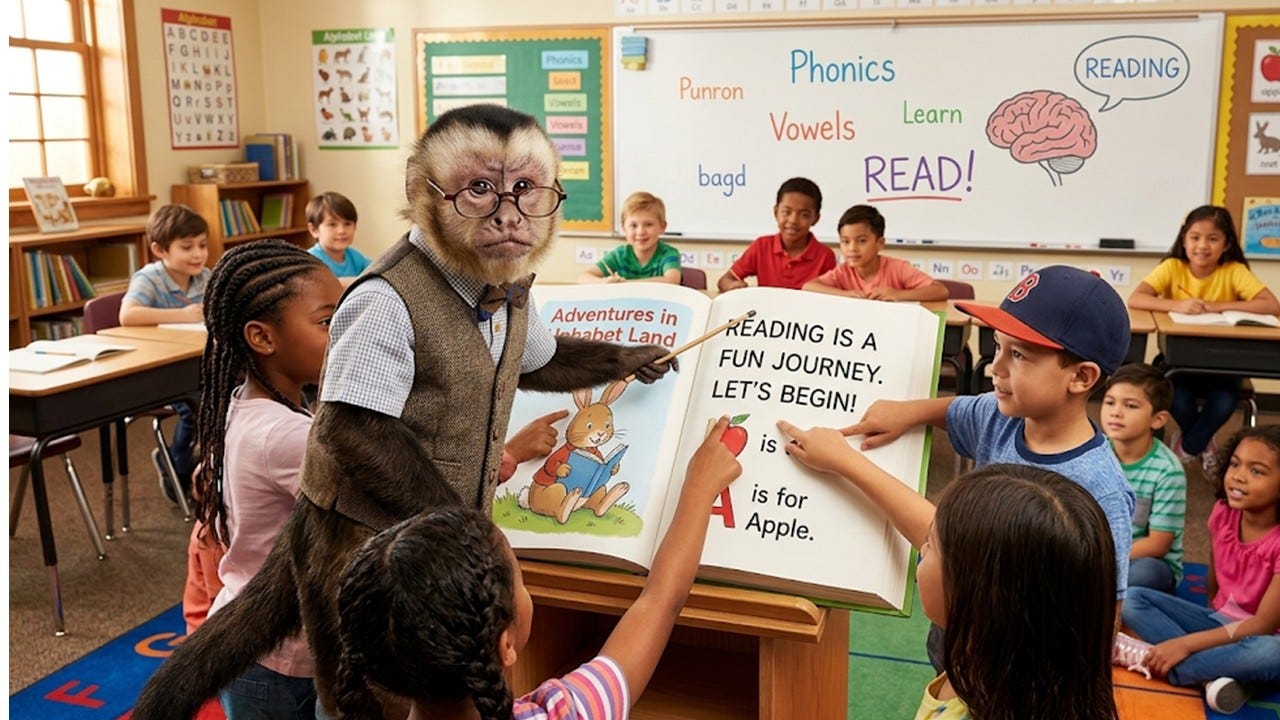
And truth be told, anybody with a 6th grade education could have come in and followed the directions in a teachers’ manual. A trained monkey could probably have taught reading as well as I did back in the 80s (see Figure 4.1).
Figure 4.1. Trained monkey teaching reading.
Unenjoyment
If I want to be honest (and I do), I didn’t enjoy teaching reading in the 80s. And my students didn’t enjoy my teaching of reading to an even greater degree. Nobody enjoyed much of anything back then. Reading class was 60 minutes of unenjoyment. All of us would have much rather have been outside on the playground kicking red rubber balls into the air. But there we were, stuck inside doing stuff that nobody enjoyed because we had to. As a result, my students learned how to unenjoy reading. Even though there were no behavioral objectives related to unenjoying reading, that was the outcome.
Back in the 80s, the stories in the teachers’ manuals were designed to reinforce the letter patterns being taught. Reading the back of a cereal box would have been more interesting than the mush students were forced to read out loud at small tables using round-robin reading. Students never talked about or made connections with anything they read. They never had opportunities to practice using the skills they learned in reading class by reading real books. Students only got to find a book to read when their “work” was finished. There was no time set aside for daily reading. And students copied things but never wrote their ideas on paper for others to read.
In retrospect, I realize that many of my 2nd grade students learned to read despite my fidelity to the teachers’ manual, not because of it.
Nutty New Whole Language
I first heard about whole language back in 1988. Like anyone who encounters something new, I used the file folders in my head to try to make sense of it (Piaget, 1957). The file folders in my head related to reading instruction were filled with my own experiences learning to read in the 60s as well as all the sounding-out-word stuff in the teachers’ manual. That’s it. Nothing in my teeny-tiny cognitive file folders enabled me to understand this more complex understanding of literacy and language. So of course, it made no sense to me. I compared the new to the old and since it didn’t match, I declared the new to be nutty. It was nonsense. It was silly. It was wrong. I came to this conclusion based on a very shallow and disjointed knowledgebase. And in this way, I was no different from the Minnesota state legislators who passed The Read Act in 2023.
The small tidbit of whole language information was quickly put in a file folder in my head marked “crazy stuff”, filed away, and forgotten.
Infidels
The story would normally end there; however, a couple years later, I entered a Ph.D. program at the University of Minnesota. For five years I was able to study and immerse myself in research literature related to learning, literacy, and literacy instruction. I had conversations with imminent literacy scholars and read lots of research articles. Just as important, I supervised practicum students and student teachers out in the field. I was able to visit hundreds of classrooms in and around the Twin Cities area. Here I saw reading classes that were interesting and enjoyable. Students were reading books, having conversations, writing things about reading, writing things about other things, and generally using literacy for real life purposes. Direct and explicit instruction was used to teach phonics and other reading subskills, but it occurred within the context of authentic reading and writing activities. And the stuff I was experiencing in the field aligned with all the new stuff I was learning about literacy, cognitive psychology, linguistics, and how humans being learn (Anderson, 1983, Bowery, 1986; Cambourne, 1993; Goodman, 1967; Goodman, 1985; Kintsch, 1988; McClelland & Rumelhart, 1981; Pressley et al., 1992; Rummelhart, 1994; Weaver, 1998).
But in these interesting and enjoyable reading classes, there were no teachers’ manuals! How was that possible? How could any learning possibly occur without a teachers’ manual? How did teachers know how to teach reading without being able to follow directions? How did they know what to teach? How did they know what to say without a teaching script? How did students learn new words without vocabulary worksheets? How did students learn how to comprehend without comprehension worksheets? How did teachers know if learning occurred without end-of-unit tests? And how did teachers know who was a high, middle, and low reader? And if they weren’t following a teachers’ manual with fidelity, did that mean these teachers were infidels?
As a literacy professor at Minnesota State University in Mankato in the mid-90s, I was able to continue to visit classrooms across southern Minnesota and expand my research agenda. The 90s and 00s were a golden time for literacy instruction. Literacy was good. Infidelity was rampant. Unenjoyment seemed rare.
“What about the test scores?” you ask.
What about the test scores?
“Didn’t all that whole language stuff make test scores drop?”
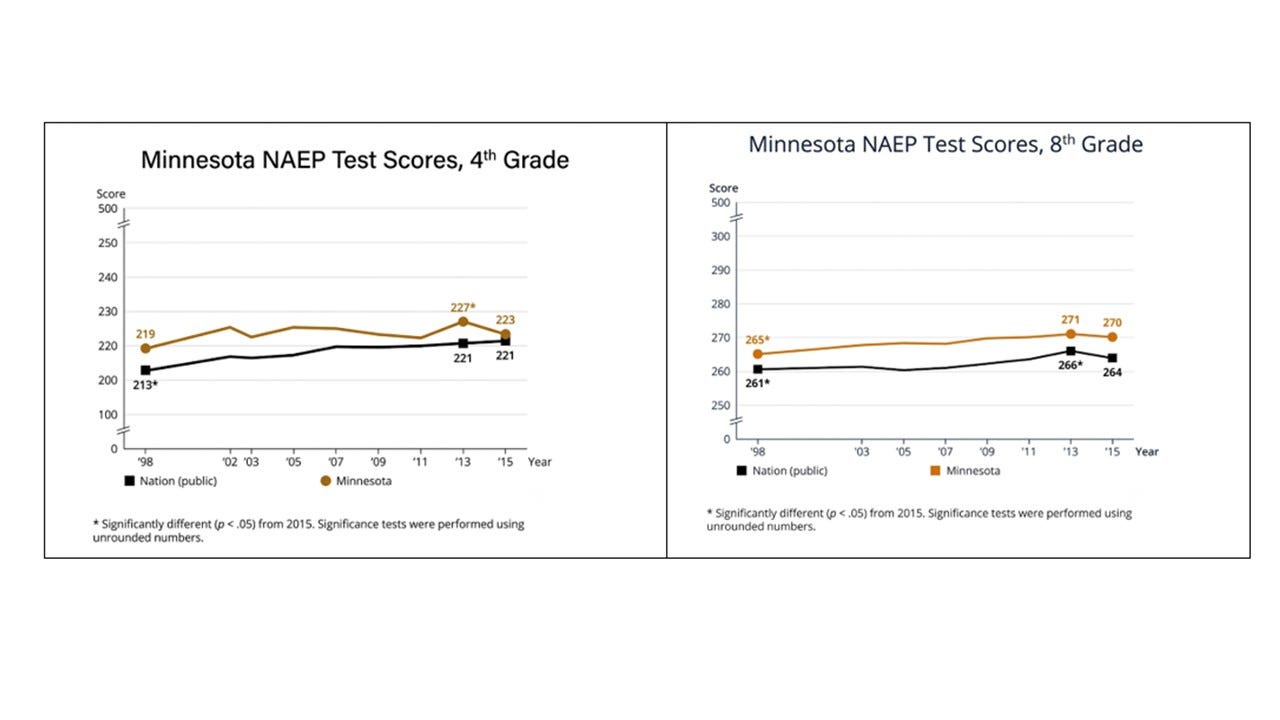
The test scores were just fine. If you look at the NAEP reading test scores for Minnesota Students in 4th and 8th grade from 1998 to 2011 (see Figure 4.2) you see that Minnesota students were above the national average.
Figure 4.2. Minnesota NAEP reading scores.
“Well, what about all the whole language stuff. We all know that whole language has been debunked.”
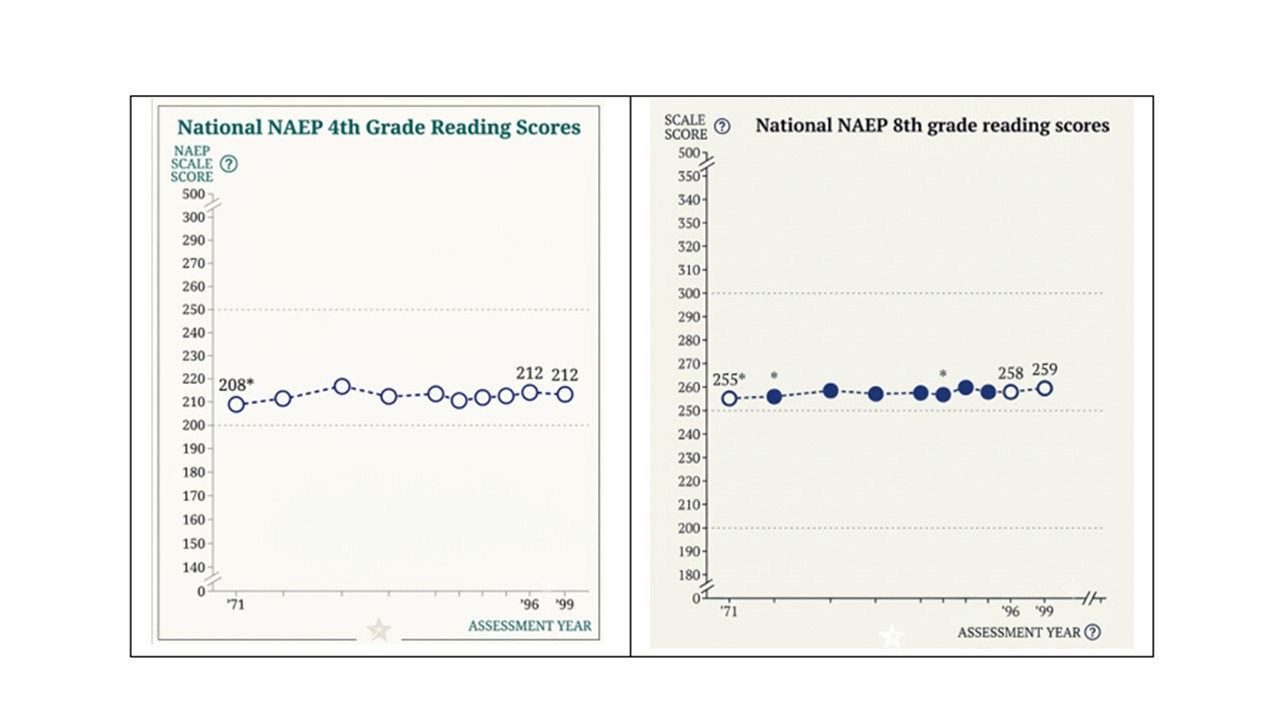
There may have been some research-illiterates who claimed it was debunked, but saying something’s debunked doesn’t make it debunked. Whole language, as a language learning theory, has never been debunked. In fact, it is fully bunked. There has never been research “proving” that whole language doesn’t work. We can see in Figure 4.3 that national reading scores were just fine during the apex of whole language in the 90s.
Figure 4.3. National NAEP reading scores.
The Real Problem
Whole language was never the problem. The real problem was that Big Publishing couldn’t make money if there were no teachers’ manuals, consumable workbooks, end-of-unit-tests, and comprehension worksheets to sell. And teachers couldn’t be controlled if they were allowed to make decisions about what’s best for their students. And if children were able to select the books that they want to read, they could end up believing all sorts of crazy shit.
It was never about whole language. It was always about money, power, and control.
The Flux Capacitor
But a blight came upon the land in the form of the National Reading Panel Report, No Child Left Behind, and the Reading First Initiative. The Education Science Reform Act of 2002 excluded certain types of research from the research conversation. And soon after, people with no expertise in reading instruction magically became experts in reading instruction. Behavioral psychologists, accountants, medical doctors, neuroscientists, physicists, journalists, business “leaders”, linguists, educational psychologists, speech therapists, psychometricians, politicians, government employees, direct instruction specialists, conservative think tanks, the National Council on Teacher Quality, Education Week, and secretaries of education were now experts in reading instruction. Some of these new magical reading experts were so powerful, they could tell us what research said about reading instruction without ever reading a research article.
Imagine that.
And literacy experts who had spent decades developing their expertise through teaching, research, service, and scholarly work, were magically transformed from experts into speed bumps on the road to profit-based reading instruction. And slowly, starting in the early 2010s, all the joy started being sucked out of reading classes across Minnesota. Today, you’d be hard pressed to find a reading class in Minnesota in which students are engaged in authentic literacy activities.
In 2026, the Minnesota Department of Education requires teachers to be toadies who follow approved teachers’ manuals with fidelity. All the love of reading has been stomped out of students. Reading, writing, listening, thinking, and critically evaluating information has been replaced by remembering, responding, regurgitating, and filling in bubbles on standardized tests.
This story ends where it began, in 1981. The Read Act Minnesota is the flux capacitor that has brought us screaming forward to the past (see Figure 4.4). We’ve been transported back to 1981 but it’s much worse this time around.
Figure 4.4. Flux capacitor.

Lessons From a Speedbump
Whole language is not a method or an approach. It’s a language learning theory that states that literacy learning occurs best in the context of whole and meaningful literacy experience. Direct, explicit, and systematic instruction of phonics occurs within this context. Below are ten conditions that align with whole language learning theory that will enable all students to develop their full literacy potential.
Instruction (including phonics instruction) should occur within meaningful contexts to the greatest degree possible.
Ample time should be provided every day for children to practice reading authentic texts that they have selected.
Ample time should be provided every day for children to engage in authentic writing about topics that they have chosen.
Teachers should have the autonomy to make instructional choices based on the needs and interests of the students in their classrooms.
Basic skills (including phonics) should be taught systematically. Systematically does not mean that a predetermined list of skills should be taught in a predetermined order and in a predetermined way. Instead, it means that basic skills should be taught (a) as needed, (b) as students are ready for them, (c) in ways that children can best learn them, and (d) in the context of authentic reading and writing experiences to the greatest degree possible.
Instruction and activities that develop students’ ability to utilize all types of information to recognize words (phonetic, syntactic, and semantic) should be included.
At all levels, literacy instruction and activities should go beyond merely decoding to include reading, writing, speaking, thinking, and listening.
The instructional focus should be primarily on creating meaning with print (reading) and using print to create and express meaning (writing).
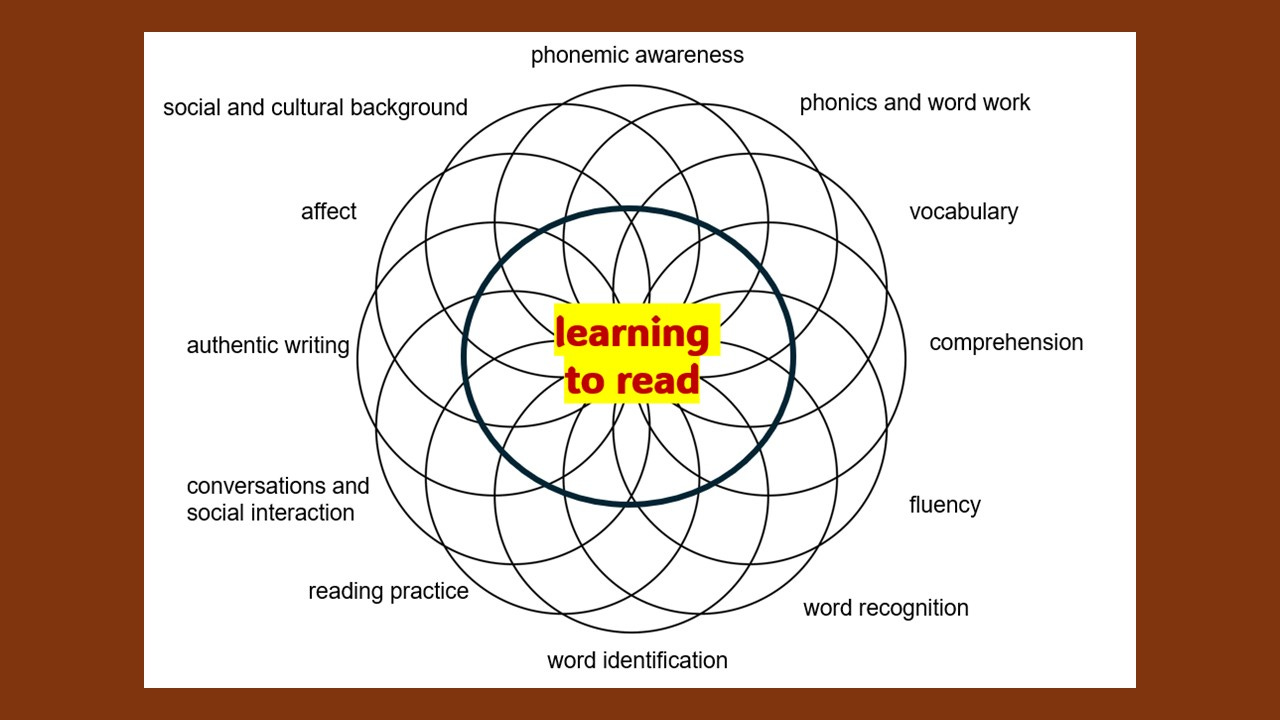
Reading instruction should involve 12 interacting and interdependent elements (see below), of which conversation and social interaction are an integral part.
If commercial reading programs are used, they should be adopted and adapted to incorporate the defining attributes here.
Truly Comprehensive Reading Instruction
The National Reading Panel identified what they determined to be five “essential” or “core” components of reading instruction. These are indeed essential, but they are seven components short. A truly comprehensive reading instruction contains 12 interacting and interdependent components. These are essential in varying degrees for students of varying interests, abilities, backgrounds, and cognitive strengths. (see Figure 4.5)
Figure 4.5. Truly comprehensive reading instruction.

I don't think I quite appreciated the gravity of the of the economic incentives behind teachers’ manuals, consumable workbooks, end-of-unit-tests and comprehension worksheets, a kind of teacher support commodification, which seemed to have significant leverage against whole language reading.
Embedding phonics instruction into the whole language approach is also not something I often encounter on Substack and elsewhere, with the usual debate appearing very polarised (and often strongly against language reading). Do you see the 'science of reading' movement adopting a more balanced and integrated approach in the future, or do you think this debate will remain murky? I'd be curious to hear your view.
Many thanks for your work on this and I'd be very interested to read the rest of your book.
I'm new here, and I want to thank you for validating my experiences as an elementary classroom teacher and eventual reading specialist. I too started my university experience in 1980 with some of the groundbreakers in whole language--Jerry Harste and Carolyn Burke at Indiana University. Dr. Burke was responsible for the Reading Methods courses for the undergraduates in elementary ed. I was inspired by her to take more reading classes for my minor in reading. We were reading Frank Smith's 'Understanding Reading' and looking at multiple sign systems that Jerry Harste had started to incorporate in an instructional model that closely resembles your integrative model. Burke looked at what she termed "The Linguistic Data Pool" wherein all of the strands of language use reinforce all the other strands. The model was “open” and included social pragmatic cues in addition to grapho-phonics, syntax, and the semantic core that drives everything else.
After a total of 35 years teaching in mainly urban settings, I eventually retired as a reading specialist in 2020 working in a suburb in the Washington DC Metro area (28 years). We had a diverse community of refugees and immigrants comprised of many languages and countries of origin. Our ESL population was close to 90%. When I started in this school district it was 1992 and new ideas about how to teach reading and writing were starting to flourish. We had a solid group of teachers who had learned how to "use all of the tools in the toolbox" in order to provide a curriculum that would meet kids where they were and move them along. We were doing balanced literacy, process writing, and content area reading that took advantage of background knowledge and schema theory tying it all together. We even had an established Reading Recovery Training program.
Then after I left in 2020, things started to change with the Science of Reading taking over the reading curriculum. Guided reading and Fountas and Pinnell leveled books were thrown out and a process approach to writing was supplanted with formulaic tasks akin to copying texts from the board. Common Core materials were used in the primary grades that were above the average student’s listening comprehension. As a reading specialist we were used to taking running records and using oral reading inventories to record miscues and monitor comprehension. This was replaced by the DIBELS test which left people short changed when it came to analyzing miscues and evaluating comprehension with open ended retellings.
Thank you for listening. Your emails are a breath of fresh air and I hope more people start to realize what we gave up for SoR.