
Teaching Basic Study Skill Strategies for Reading Textbooks


This is an excerpt from my book -- Johnson, A. (2017). Teaching strategies for all teachers. Rowman and Littlefield
A study skill strategy is a process used to create meaning with expository text (textbooks). For students to use them, they have to be easy to use and practical. Below are seven such strategies. These should be taught explicitly and reviewed every year.
The Strategies
• 5-step basic note-taking strategy. Guided notes (above) is a good introduction to note-taking. This provides the structure necessary for students to develop their own note-taking strategy. Then teach a very basic form of note-taking (see Figure 23.5). Keep it simple. Students will naturally develop more complex forms of note-taking as the need arises.
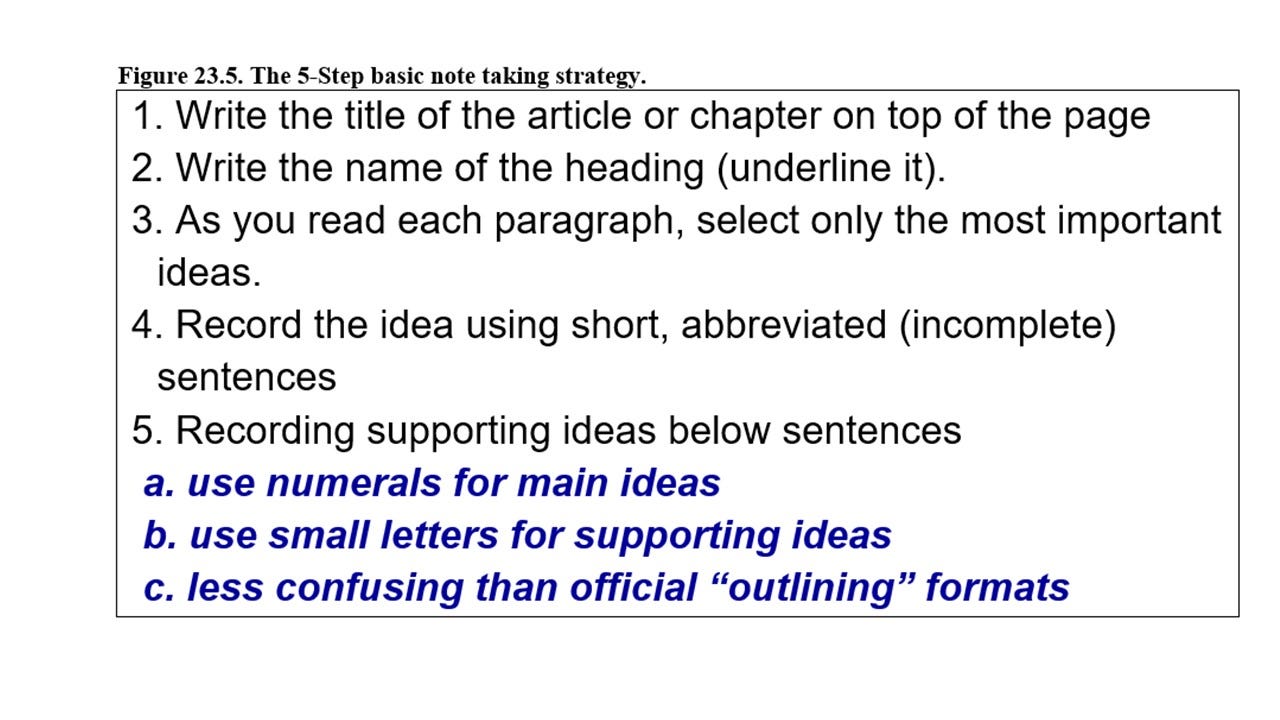
• Read, dot, and record. When reading expository text, you sometimes do not want to interrupt the reading flow by stopping to record notes. Instead, put a dot in the margin of the text with a pencil to identify important ideas as you are reading. (You can erase the dots later.) After reading, go back and take notes using the 5-step basic note-taking strategy above.
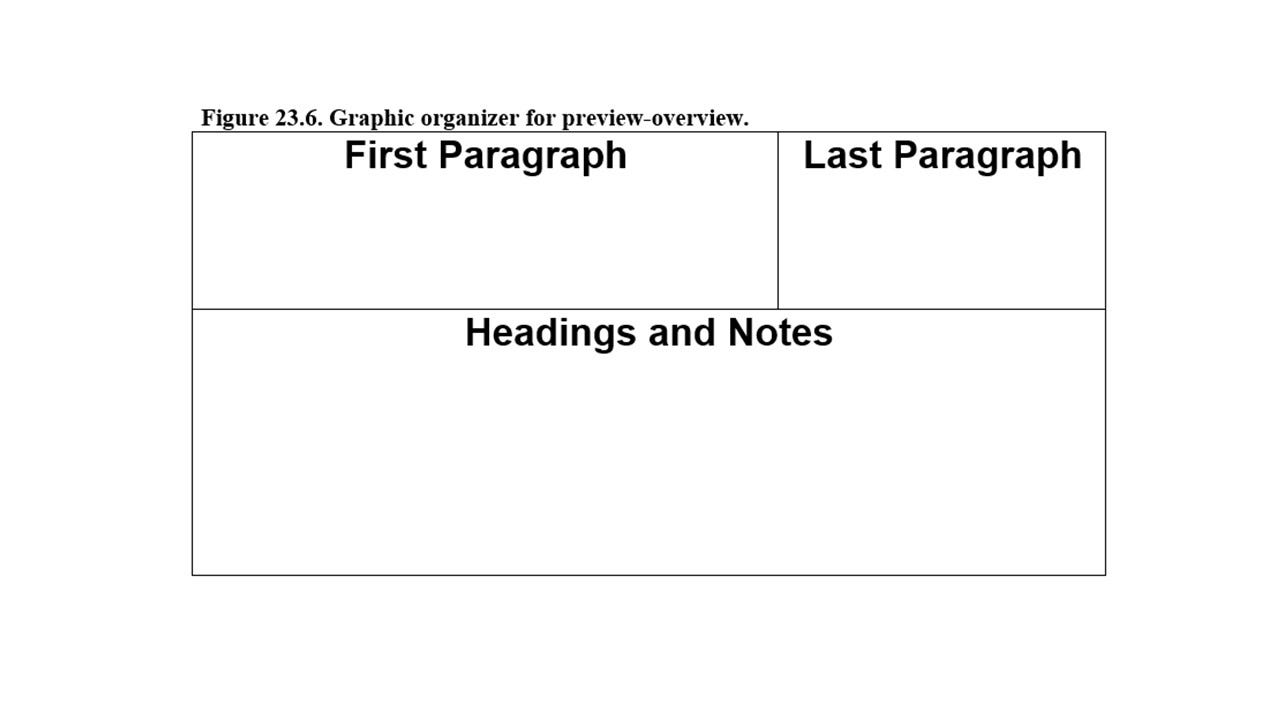
• Preview-overview. Start by reading the first paragraph, the headings and subheadings, and the last paragraph. Then read the entire text and take notes. The graphic organizer in Figure 23.6 can be used to teach this process. The first two sections are used to list ideas found in the first and last paragraphs. The last section is used for notes.
• Read and pause. First, read a paragraph. Then pause to see if you understood and can restate an important idea. If so, resume reading. If not, return and re-read.
• Paragraph re-read. Read a paragraph. Then skim to find an important idea. Continue.
• 3x5 card. A 3x5 card helps to keep you focused as you read. Some prefer to put the card on top of the line they are reading and move down. This allows their eyes to naturally predict and move ahead. Others prefer to put the card underneath the line they’re reading. This can also be used in conjunction with any of the strategies described above.
• Skim, re-read, and note. Quickly skim the text to get a sense of the whole. Then they re-read and take notes as you read.
Tips for Teaching Study Skill Strategies
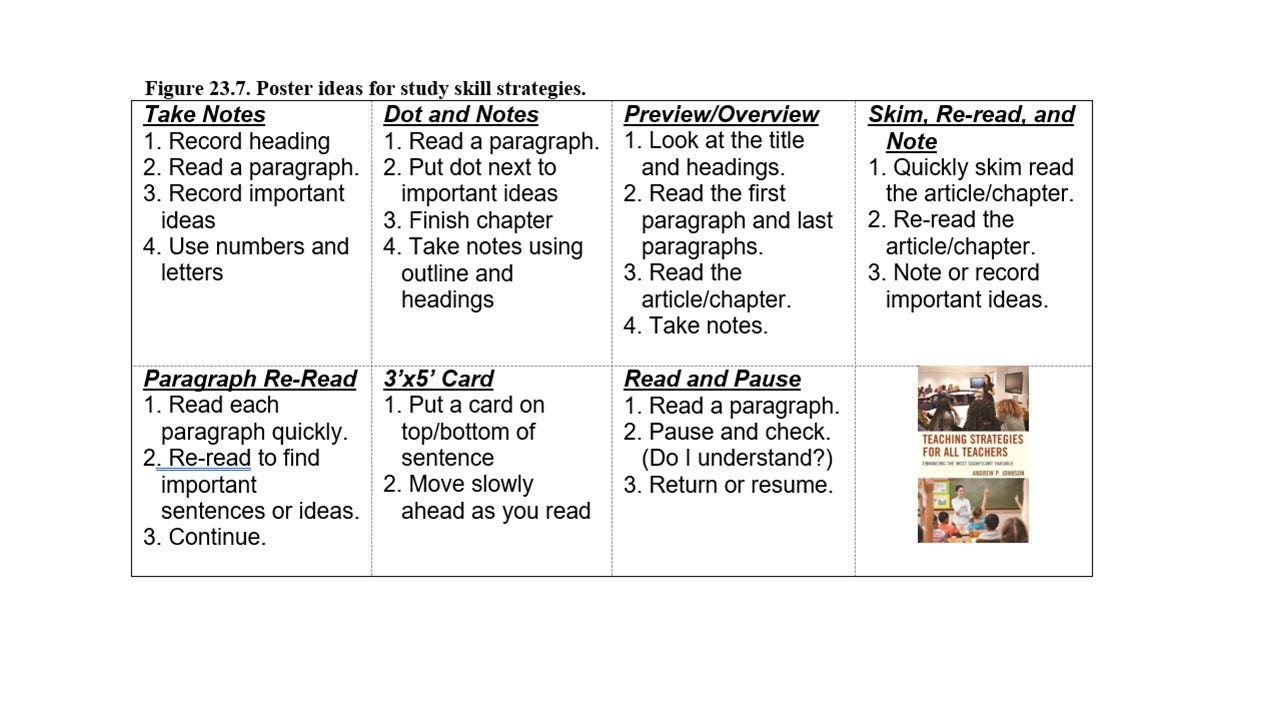
Starting at the beginning of each year, teach one or two of the study skill strategies described in this section. Keep it simple and practical, adopt and adapt, and encourage students to use the strategies that work best for them. Also, create a poster to display the study skill strategies that you will teach in your classes (see Figure 23.7). Break each study skill strategy into specific steps. When assigning a text, always remind students to use one of these study skill strategies.
FINAL WORD
All teachers should be teachers of reading in some form. This chapter described seven simple study skill strategies that can be used to help students create meaning with expository text.
This type of studying/note-taking is harder to do now that most textbooks are online -- which (hopefully) may change, with all the parental backlash against excessive screen time in schools. It seems as though textbook publishers like it better when schools and/or students are paying for their wares over and over again, rather than just once. It's essentially the same reason companies want you to stream your movies and music, rather than just buy a CD or DVD.
On a somewhat related note, I once worked for a lawyer who said he had been diagnosed with dyslexia. He said his study strategy was to write a summary in the margins every few paragraphs and then go back afterwards and re-read his notes. I wonder if someone who is struggling with reading comprehension and remembering what they read could open up a speech recognition app and take oral notes into it every few paragraphs. I know (or at least I think i know) handwriting helps with remembering, but I wonder if a system of read/retell/read/retell coupled with speech recognition could be good enough.