
Why Johnny Can’t Read Research Articles
send this to your state representatives and senators

“The National Institute of Dendrology found that 97.4% of all state legislatures can’t read research articles at the basic level (Goaldenburg, 2025, p. 423).”
Reading Instruction Laws are a Bad Idea
Federal and state governments are essential for setting general policies and regulations related to education; however, they have no business dictating curriculum content or instructional practice in any content area, especially reading instruction. There are five reasons why this is so:
1. Community control. Public education was designed to be under local community control (Brace, 2023). This enables public schools to meet the needs and values of the people living in their communities.
In Milliken v. Bradley, the Supreme Court declared “local control” the single most important tradition of public education” (Brace, 2023, p. 97).
2. Knowledge gap. Recent test scores show there’s a widening knowledge gap between state legislators and experts in the field of reading instruction (Shahanahanagan, 2026). Also, brain imaging research has proven that being able to read at the 6th grade level does not make one an expert in the field of reading instruction (Saidenburg, 2025). And in her landmark study, Earry wrote:
“The National Institute of Dendrology found that being elected to something does not make one an expert on anything, especially reading instruction. It just made them elected” (Earry, 2025, p. 781).
3. Inability to read research articles. In a recent study, it was shown that 97.4% of all state legislators scored below the basic level on the Reading Research Articles Tests (Goaldenburg, 2026). In his now famous book, Why Johnny Can’t Read Research Articles, Randahl Flesh (2026) argued that this was because state legislators looked at all the letters and sounded out all the words instead of reading for understanding.
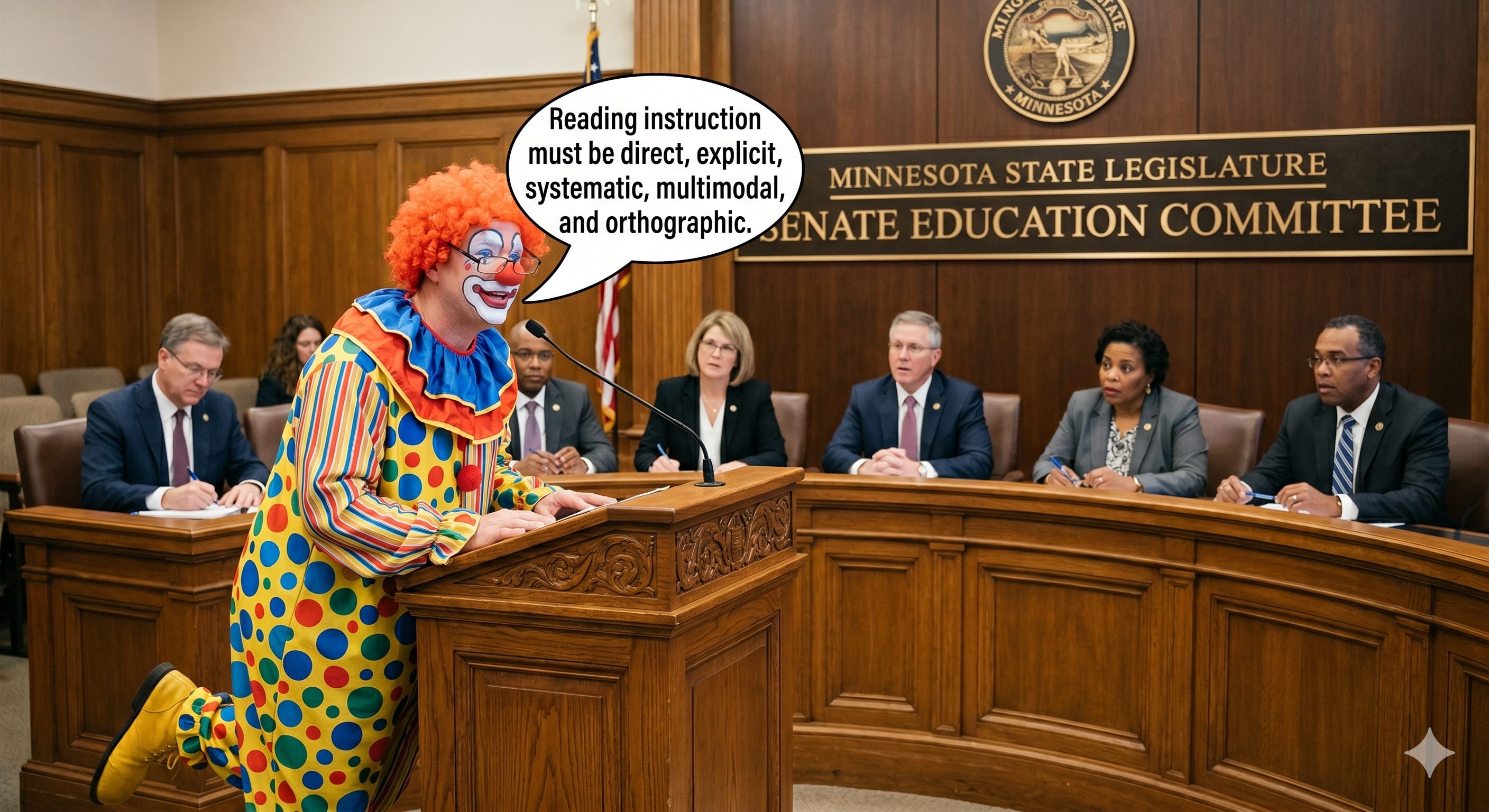
4. Clown testimony. People who testified before state legislators were selected because they believed the same things as the people who called them in to testify (Motes, 2025). Research shows that if you call clowns in to testify, you will get clown testimony (Shworts, 2026). Across the country, Science of Reading laws are based largely on clown testimony (Scarrburrow, 2026).
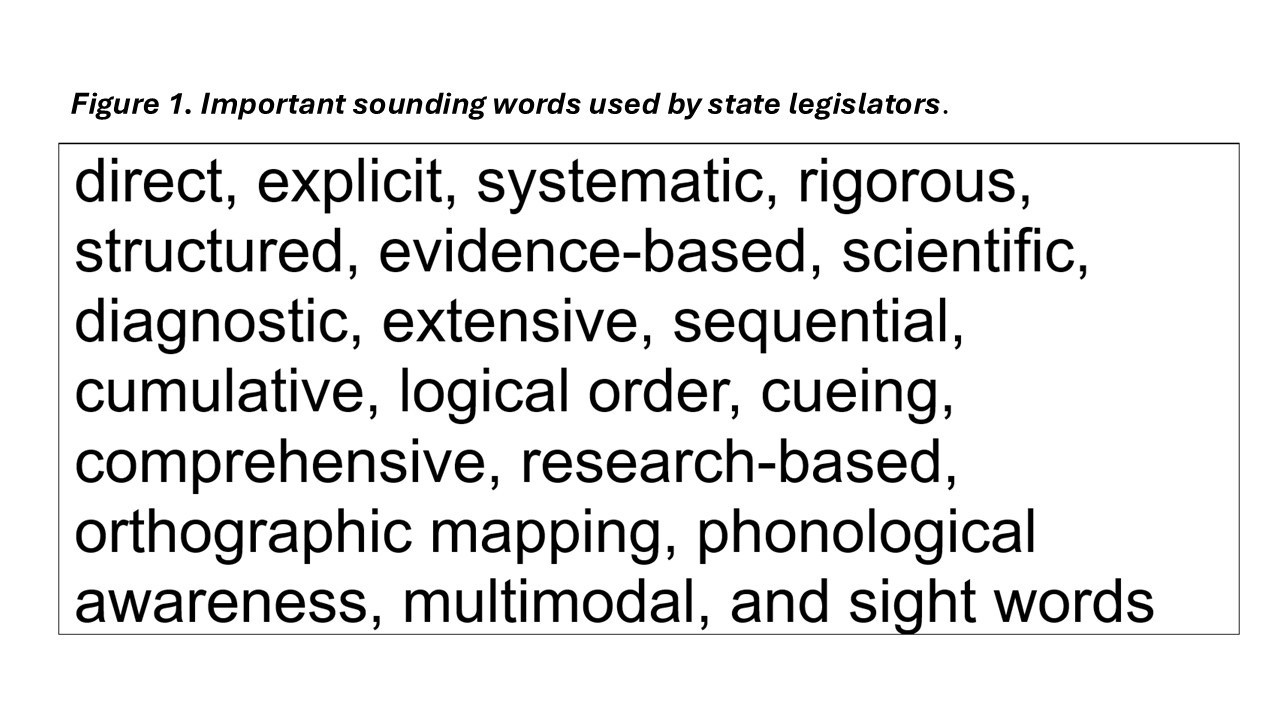
5. Important sounding words. Using important sounding words is different from understanding what they mean. Dennaheehaw (2025) found that the words in Figure 1 were commonly used by state legislators; however, only 3.5% knew what they meant in the context of reading instruction. While they elicited an emotional response, these words did not transmit information.
Conclusions
Teaching reading is an academic endeavor. Decisions about how to best teach reading should be made in an academic context, not in a political context. Unlike the discourse occurring in state capital, in an academic context a full range of research and theoretical perspectives are allowed into the conversation. Discussants here understand that reading instruction is not “a settled science”. And unlike political discourse, participants in academic discourse know the meaning of the words they use.
References
Brace, C. (2023). Revisiting the “tradition of local control” in public education. Michigan Law Review, 122, 99-120.
Dennaheehaw, S. (2025). I know more than you do. Dendrology Today, 2, 24-39.
Earry, L. (2025). Expertise and state legislators: A widening crisis. National Institute of Dendrology.
Flesh, R. (2026). Why Johnny Can’t Read Research Articles. Fordham Institute of Dendrology.
Goaldenburg, C. (2025). Crisis in research reading scores. Journal of Dendrology, 48, 223-301.
Motes, K. (2025). Send in the clowns. The International Journal of Dendrology and Palynology, 37, 223-224.
Scarrburrow, I. (2026). The simple view of reading research articles. Dendrology Review, 32, 21-39.
Shahanahanagan, R. (2026. January). Research article wars. Dendrology Magazine.
Sworts, S. (2026). Clowns who testify. Dendrology Weekly, 54, 34-98.
Join the Conversation

The International Literacy Educators Coalition
Push back against top-down SoR mandates that disempower teachers. Get involved with the International Literacy Educators Coalition (ILEC). It’s free.
You know there's a problem when two venture capital companies are competing for the same public dollars, and they've both been written into state laws ensuring the money will keep flowing to them.
While this had me laughing the entire time, you make some very important points!