


This is an excerpt from my book, Designing Meaning-Based Interventions for Struggling Readers.
Eye Movement
Your eyes do not move evenly from left to right as you read. Instead, they move in small, jerky movements called saccades. Your eyes will skip some words, stop on some words, and even go back and stop on words previously read. It only appears as if your eyes are move smoothly from let to right because your brain is filling in the blanks. The movement your eyes across the page while reading is illustrated by Figure 3.7. The line represents the path your eyes take. The dots are stopping points or fixations.
Figure 3.7. Eye movement during reading.
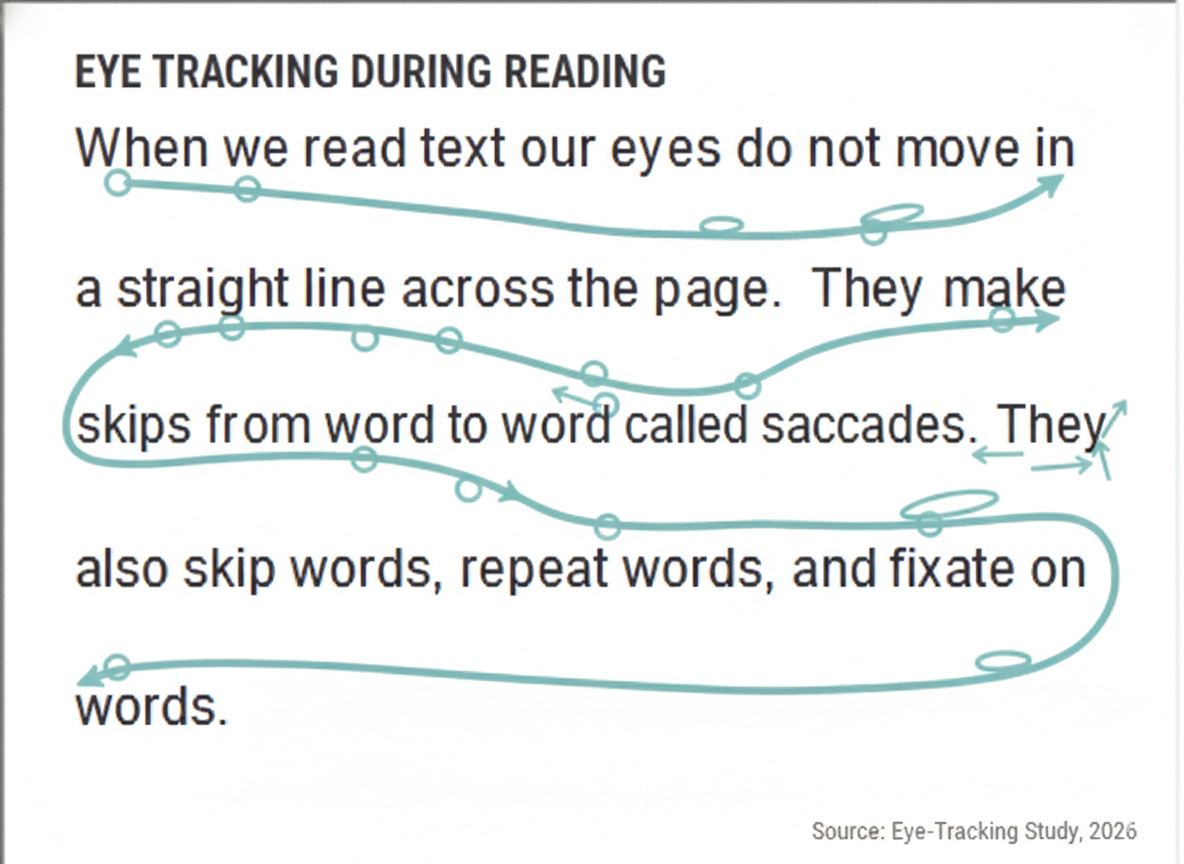
Your eyes fixate on approximately 60% of the words as you read (Paulson & Goodman, 2008). Of these fixated words, your eyes usually stop on only one or two letters. Since we can perceive only those things upon which our eyes fixate, it is clear, that your brain is filling in the blanks as we read. During reading, minimal letter cues are used, along with syntactic cues, semantic cues, and the information in our cortex, to confirm or revise words as your brain creates meaning with print.
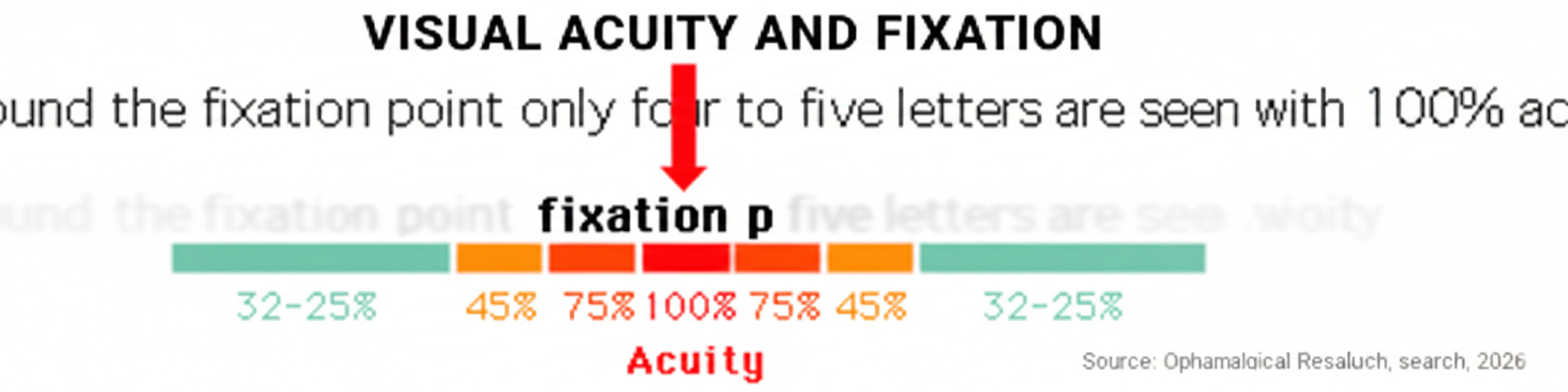
Your eye has three visual regions: foveal, parafoveal, and peripheral (see Figure 3.8). The foveal takes up only 1% to 2% of your total vision. This is the point of fixation where you are able to see clearly and process details. You can take in only about three to six letters here. The parafoveal is the region directly surrounding the foveal region. Here you are able to take in about 24 to 30 letters, however, not very clearly. In this region you can identify gross shapes but without some sort of context, the strings of letters are indistinguishable. The peripheral region is everything else. Here you are able to perceive only gross shapes.
Figure 3.8. Foveal, parafoveal, and peripheral regions.
So, with this very small in-focus viewing area how is anybody able to read more than 10 words per minute? Efficient readers are able to read quickly because of the top-down flow of information as described in the last chapter. When we read, we use the information in our head along with the context of what we are reading (semantics) and the syntax of the sentences to make predictions about the upcoming text. These predictions enable us to make sense of the semi-blurred letters found in the parafoveal regions and to identify words. Efficient readers do not process every letter in a word or every word in a sentence (Kucer 1014); rather, they recognize words using semantics, syntax, and minimal letter clues. Because we are creating meaning with print, our brain only tricks us into thinking we have looked at every letter in every word.
REFERENCES
Engel, A.K., Fries, P, and Singer, W. (2001). Dynamic predictions: oscillations and synchrony in top-down processing. Nature Reviews Neuroscience, 2, 704-716.
Hawkins, J. (2004). On intelligence. New York: Holt
Johnson, A. (2016). 10 essential instructional elements for students with reading difficulties: A brain-friendly approach. Thousand Oaks, CA: Corwin
Koch. C. (2004). The quest for consciousness: A neurobiological approach. Englewood, CO: Roberts and Company Publishers.
Kucer, S.B. (2014). Dimensions of literacy: A conceptual base for teaching reading and writing in school settings. (4th ed). New York, NY: Routledge.
Paulson, E.J. & Goodman, K.S. (2008). Re-reading eye-movement research: Support for transactional models of reading, 25-50. In A Flurky, E. Paulson & K Goodman (Eds.) Scientific Realism in Studies of Reading, New York: LEA.
Siegel, D.J. (2007). The mindful brain. New York, NY: W.W. Norton & Company, Inc.
Strauss, S. (2005). The linguistics, neurology, and politics of phonics: Silent “E” speaks out. New York: Routledge.


